Wondering how to calculate cumulative GPA? Your cumulative GPA is the single number that summarizes your entire academic record — every course, every semester, all combined. Colleges, scholarships, and employers all look at it. This guide explains what cumulative GPA means, the exact formula, a worked example, and how to calculate yours in seconds.
Short answer: A cumulative GPA calculator takes your total quality points (grade points × credit hours, summed over all courses) and divides by your total credit hours. Use the free GPA calculator — enter every course from all semesters and get your cumulative GPA instantly.
What Is a Cumulative GPA?
What is a cumulative GPA? It’s the weighted average of all the grades you’ve earned across every semester of your academic career, combined into one number on (usually) a 4.0 scale.
It differs from your semester GPA, which covers just one term. Your cumulative GPA answers the bigger question: “How have I done overall, across everything so far?”
Why it matters:
- College admissions — transfer applications and graduate schools weigh cumulative GPA heavily
- Scholarships — most merit scholarships require a minimum cumulative GPA (often 3.0 or 3.5)
- Honors and Dean’s List — based on cumulative, not single-semester, performance
- Employers — some graduate programs and employers ask for it
Cumulative GPA Formula

The cumulative GPA formula is straightforward:
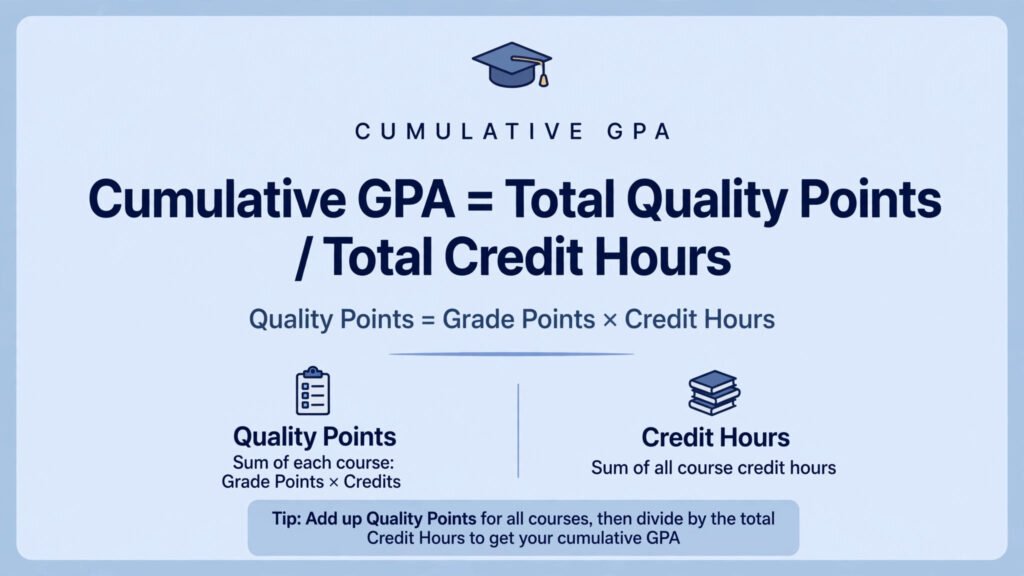
Cumulative GPA = Total Quality Points ÷ Total Credit Hours
Where:
- Quality points for one course = grade points × credit hours
- Total quality points = sum of quality points for every course you’ve taken
- Total credit hours = sum of credit hours for every course
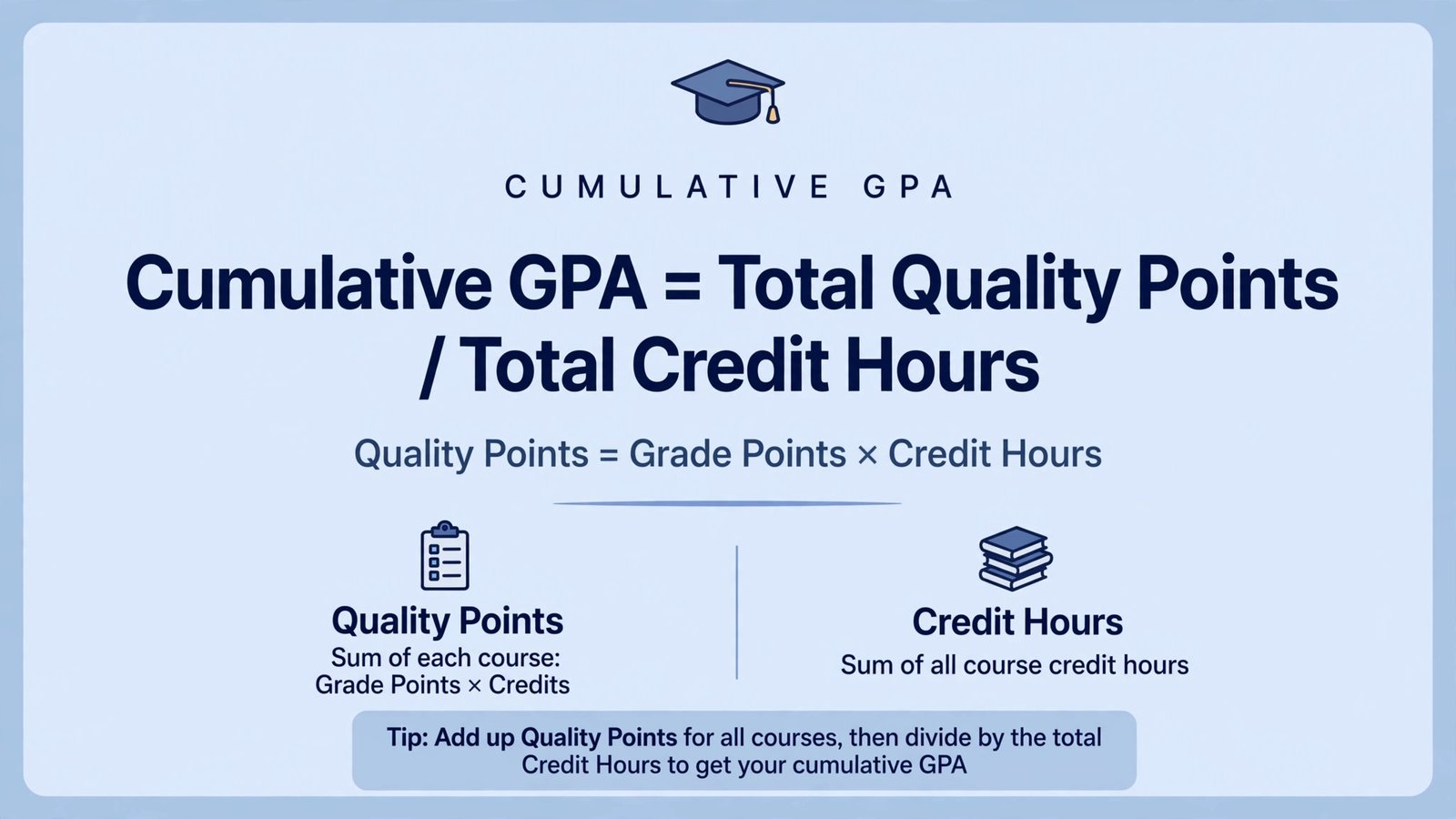
In plain English: convert each grade to its point value, multiply by the course’s credits, add everything up, then divide by your total credits.
How to Calculate Cumulative GPA: Step by Step
Here’s how to calculate cumulative GPA manually:
- Step 1: List every course. Write down each course you’ve completed, its letter grade, and its credit hours. Include every semester — not just the current one.
- Step 2: Convert grades to grade points. Use the standard 4.0 scale (A = 4.0, B = 3.0, C = 2.0, D = 1.0, F = 0.0; plus/minus grades fall in between — see the table below).
- Step 3: Calculate quality points per course. Multiply each course’s grade points by its credit hours.
- Step 4: Add up the totals. Sum all quality points into one number. Sum all credit hours into another.
- Step 5: Divide. Total quality points ÷ total credit hours = your cumulative GPA. Round to two decimal places.
Worked Example

Let’s walk through a real example. Suppose you’ve completed two semesters:
Semester 1:
- English 101: A (4.0) × 3 credits = 12.0 quality points
- Math 101: B+ (3.3) × 4 credits = 13.2 quality points
- History 101: B (3.0) × 3 credits = 9.0 quality points
- Biology 101: A− (3.7) × 4 credits = 14.8 quality points
Semester 2:
- English 102: A (4.0) × 3 credits = 12.0 quality points
- Math 102: B (3.0) × 4 credits = 12.0 quality points
- Chemistry 101: C+ (2.3) × 4 credits = 9.2 quality points
- Psychology 101: A (4.0) × 3 credits = 12.0 quality points
Totals:
- Total quality points: 94.2
- Total credit hours: 32
- Cumulative GPA: 94.2 ÷ 32 = 2.94
Doing this by hand for 40+ courses is tedious — that’s exactly what a cumulative GPA calculator automates.
Grade Point Scale (4.0)
| Letter Grade | Grade Points |
|---|---|
| A / A+ | 4.0 |
| A− | 3.7 |
| B+ | 3.3 |
| B | 3.0 |
| B− | 2.7 |
| C+ | 2.3 |
| C | 2.0 |
| C− | 1.7 |
| D+ | 1.3 |
| D | 1.0 |
| F | 0.0 |
Note: some schools use slightly different scales (e.g., A+ = 4.3, or no plus/minus grades). Always check your institution’s official scale for the final word.
Semester GPA vs Cumulative GPA
Semester GPA covers one term only. Cumulative GPA covers your entire academic history.
Key differences:
- A single great semester boosts your semester GPA a lot but moves your cumulative GPA only slightly (especially late in your degree — this is called “credit inertia”)
- Early semesters carry more weight: with only 30 credits banked, one 15-credit term is half your record; with 120 credits, it’s just one-eighth
- Graduate schools and scholarships almost always ask for cumulative, not semester, GPA
Does cumulative GPA include all semesters? Yes — every completed semester counts, including summer courses taken at your institution. Transfer credits usually transfer as hours only, without affecting your institutional GPA (policies vary by school).
How to Raise Your Cumulative GPA
How can I raise my cumulative GPA? The math is unforgiving but the strategy is simple:
- Earn A’s in high-credit courses. A 4-credit A adds 16 quality points — more than any 3-credit course can.
- Retake failed or low-grade courses if your school replaces the grade (many do for F/D grades).
- Front-load effort early. Because of credit inertia, strong early semesters build a cushion that protects you later.
- Use “what-if” planning. Before each semester, calculate what GPA you’d need in each course to hit your target cumulative GPA.
- Protect your GPA in heavy semesters. One bad 18-credit semester can take multiple good semesters to offset.
Use the Free Cumulative GPA Calculator
Skip the manual math. The free GPA calculator handles it:
- Open the GPA calculator
- Add a row for every course from all semesters (that’s what makes it cumulative)
- Enter each course’s grade and credit hours
- Your cumulative GPA calculates instantly
No signup, no download — it runs entirely in your browser.
Frequently Asked Questions
List every course you’ve taken with its grade and credit hours. Convert each grade to grade points (A = 4.0, B = 3.0, etc.), multiply by credit hours to get quality points, sum all quality points, sum all credit hours, then divide. Or enter everything into the free GPA calculator and skip the manual work.
“GPA” often means your semester or term GPA (one period). Cumulative GPA combines every semester into a single lifetime average. When applications ask for “GPA” without specifying, they usually mean cumulative.
Yes — all completed semesters at your institution, including summer terms. Transfer credits typically count toward degree hours but not your institutional cumulative GPA.
Yes. A 3.5 cumulative GPA is a strong B+/A− average — above the national college average (~3.1) and competitive for most scholarships and graduate programs.
It depends on how many credits you’ve already banked. Early in your degree, one strong semester can move it significantly. With 90+ credits completed, even a perfect 4.0 semester typically moves it by only 0.05–0.1 points.
At most schools, yes — an F earns 0.0 grade points but its credit hours still count in the divisor, which drags the average down. Many schools let you retake the course to replace the grade.
Conclusion
Your cumulative GPA is just total quality points divided by total credit hours — simple math, tedious by hand. Now you know the formula, the step-by-step method, and how to plan around credit inertia.
Ready to get your number? Enter all your courses in the free GPA calculator and see your cumulative GPA in seconds.
How to calculate 17 out of 20 as a percentage — the same divide-and-multiply math applies whenever you’re converting a single test or assignment score into a percentage.