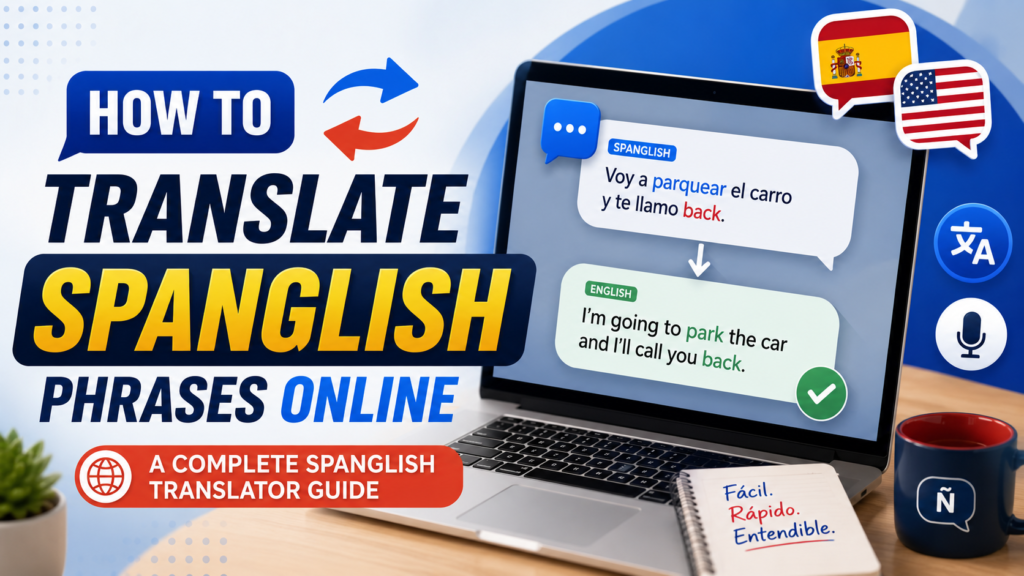
Spanglish words are the hybrid vocabulary millions of bilingual people use every day — English words given Spanish grammar (like parquear for “to park”) or Spanish and English mixed inside a single sentence. If you’ve ever read a text like “voy a parquear el carro y te llamo back” and had to guess at half of it, you already know the problem: standard translation apps are trained on formal Spanish, so they stumble on exactly these words. This guide explains what Spanglish is, gives you a working dictionary of the most common Spanglish vocabulary and phrases, and shows you how to translate Spanglish to English accurately — whether with an AI tool or by recognizing the patterns yourself.
Spanglish shows up everywhere — in family group chats, on TikTok captions, in customer reviews, in workplace Slack messages from bilingual coworkers, and in song lyrics that switch languages mid-line. It’s a real, living way that millions of bilingual people communicate every day, especially across the U.S. Hispanic community. But because it blends two languages and bends grammar rules from both, a regular Spanish translator tool often gets it wrong, or just shrugs and leaves half the sentence untranslated.
Below you’ll find what Spanglish actually is, why it confuses standard translation software, how to use a spanglish to english translator (or a combination of tools) to get translations that actually make sense, a breakdown of common Spanglish vocabulary and phrases, region-by-region differences, and practical tips so you’re not left guessing what your cousin, your client, or your favorite influencer just said.
What Is Spanglish?
Spanglish is the informal blending of Spanish and English, used mostly by bilingual speakers who move fluidly between the two languages — sometimes within a single sentence. It’s not broken Spanish or broken English. It’s its own communication style, shaped by decades of bilingual life in places with large Spanish-speaking populations.
There are generally three ways Spanglish shows up:
- Code-switching: Jumping between full English and full Spanish phrases in the same conversation. (“I love you mucho, pero ahora tengo que irme.”)
- Loanwords and anglicized verbs: Taking an English word and giving it Spanish grammar, like turning “to park” into parquear or “to email” into emailear. These converted verbs are the single biggest category of Spanglish words.
- Direct calques: Translating an English phrase word-for-word into Spanish, even when that’s not how a native speaker from Mexico, Spain, or Argentina would normally phrase it.
Linguists who study bilingual communities — including well-known research on Puerto Rican and Mexican-American speech communities in places like New York and Los Angeles — have documented Spanglish for decades. It’s a legitimate linguistic phenomenon, not a sign of “incomplete” Spanish.
Spanglish Meaning: More Than “Broken Spanish”
The spanglish meaning people usually look up is simple: it’s what happens when two languages share one brain. But the deeper meaning is cultural. Spanglish signals belonging — it says “I live in both worlds.” That’s why it carries tone and identity that a flat dictionary translation strips away. When you translate Spanglish, you’re not just converting words; you’re carrying over a way of speaking that marks community, humor, and closeness.
Spanglish vs. Standard Spanish: Why a Regular Spanish Translator Tool Falls Short
Most translation apps are built and trained on formal or standard Spanish — the kind taught in textbooks or used in news broadcasts. That’s great for translating a business email or a Spanish news article. It’s not so great for a sentence like “Voy a lonchear con mi prima y después watcheamos una movie.”
A typical Spanish translator app will often:
- Translate lonchear and watchear literally or leave them untouched, since they’re not “real” dictionary words
- Miss regional slang that doesn’t appear in standard usage
- Get confused by sentences that switch languages halfway through
- Translate idioms word-for-word, losing the actual meaning
This is exactly why a dedicated spanglish to english translator approach (rather than a generic translation tool) gets you a far more accurate result. It accounts for hybrid vocabulary, code-switching patterns, and the fact that Spanglish often isn’t “correct” by either language’s formal rules — and that’s the whole point.
Common Spanglish Words: A Mini Spanglish Dictionary


If you searched for spanglish words, this is the section you came for. Below is a quick-reference spanglish dictionary of the most common hybrid terms you’ll actually encounter — the single hybrid words (not full phrases) that trip up standard translators the most. Learn these and you’ll decode a huge share of everyday Spanglish on sight.
| Spanglish Word | English Meaning | How It’s Built |
|---|---|---|
| parquear | to park | park + -ear verb ending |
| lonchear | to have lunch | lunch + -ear |
| watchear / wachar | to watch | watch + -ear |
| textear | to text | text + -ear |
| printear | to print | print + -ear |
| emailear | to email | email + -ear |
| chequear | to check | check + -ear |
| clickear / cliquear | to click | click + -ear |
| faxear | to fax | fax + -ear |
| troca | truck / pickup | anglicized noun (very common in Texas) |
| carro | car | from English “car” (standard in Latin America) |
| suéter | sweater | borrowed noun, fully absorbed |
| overtime | overtime (work) | used as-is: “estoy en overtime” |
| brainstormear | to brainstorm | brainstorm + -ear (workplace Spanglish) |
| rufo | roof | anglicized noun (“se cayó del rufo”) |
| marqueta | market | market → marqueta (grocery run: “voy a la marqueta”) |
| puchpushear | to push | push + -ear |
| janguear | to hang out | hang out → janguear (huge in Puerto Rican / NYC Spanglish) |
| chatear | to chat (online) | chat + -ear |
| friquearse | to freak out | freak + -ear + reflexive |
How New Spanglish Vocabulary Is Formed
Notice the pattern: most new Spanglish coinages follow one formula — take an English verb, strip it to its base form, and add -ear (or -ar) so it conjugates like a Spanish verb. Once you spot that pattern, unfamiliar words like forwardear (to forward) or downloadear (to download) stop being confusing — you can translate them in your head without any tool at all. Nouns usually get borrowed whole (troca, overtime) or lightly respelled to match Spanish pronunciation.
Spanglish Examples in Everyday Sentences
Words are only half the story — here are spanglish examples showing how these words actually appear in real sentences:
- “Voy a parquear la troca y te texteo.” → “I’m going to park the truck and I’ll text you.”
- “Tengo que chequear mis emails antes del lonche.” → “I have to check my emails before lunch.”
- “Jangueamos en el mall y después watcheamos una movie.” → “We hung out at the mall and then watched a movie.”
- “No te friquíes, todo está under control.” → “Don’t freak out, everything is under control.”
Why You Might Need to Translate Spanglish Phrases Online
You don’t need to be a linguist to run into Spanglish. Some of the most common situations where people search for a way to translate it include:
- Texting or messaging bilingual family and friends who naturally mix languages
- Reading social media captions, comments, or memes that blend Spanish and English for comedic or cultural effect
- Customer service and business communication, especially in industries serving bilingual customers in retail, healthcare, or hospitality
- Learning Spanish informally through music, TV, or conversation, where Spanglish slang shows up constantly
- Content moderation or community management, where understanding the real meaning of a mixed-language comment matters
- Workplace communication in bilingual teams, where quick Spanglish phrases get dropped into emails or chat threads
If any of these sound familiar, you’re not alone — Spanglish translation requests are one of the fastest-growing niches in everyday online translation, simply because so much real-world communication doesn’t fit neatly into “100% Spanish” or “100% English.”
How a Spanglish to English Translator Actually Works


A good spanglish to english translator (whether that’s an AI chat tool, a specialized app, or a human translator who’s bilingual and bicultural) works differently from a basic dictionary-style translator. Here’s what separates a strong tool from a weak one:
- It recognizes hybrid vocabulary. Words like parquear, emailear, textear, and printear aren’t in a standard Spanish dictionary, but they’re extremely common in everyday Spanglish. A capable translator flags these as anglicized verbs and translates them based on meaning, not literal spelling.
- It handles mid-sentence code-switching. Instead of translating word-by-word, it reads the whole sentence to figure out which parts are English, which are Spanish, and how they fit together.
- It understands regional slang. Spanglish in Miami doesn’t sound like Spanglish in Texas or New York City — more on that below. A solid translator (or a person doing the translating) accounts for that variation instead of assuming one “version” of Spanglish applies everywhere.
- It catches idioms instead of translating literally. A phrase like “está en otra onda” doesn’t mean “it’s on another wave” — it means someone is “on a different vibe” or thinking differently. Literal translation kills the meaning.
This is also where AI chat-based tools have an edge over older, rule-based translation software: you can paste a sentence into a free AI chat and ask a follow-up question like “what does this actually mean in context?” — and get a real explanation instead of a flat, sometimes nonsensical translation.
Best Ways to Translate Spanglish Phrases Online, Step by Step
If you’re trying to figure out what a Spanglish phrase means right now, here’s a practical approach that works well in most cases.
Step 1: Start With a Context-Aware AI Tool
Rather than pasting a phrase into a basic word-for-word translator, use an AI assistant or chat-based tool and give it the full sentence, plus any context you have (who said it, in what setting). For example, you can ask Shaheer GPT to translate Spanglish with the full conversation context attached. Context dramatically improves accuracy, especially for slang and anglicized verbs.
Step 2: Cross-Check Slang With a Spanish Slang Dictionary
Online Spanish slang dictionaries and community-run glossaries are great for catching regional terms that general translators miss.
Step 3: Check Bilingual Communities and Forums
Communities built around bilingual life — language-learning forums, regional subreddits, and bilingual social media groups — are often the fastest way to confirm slang that’s specific to a city or generation. If a phrase still doesn’t make sense after a tool translation, searching the exact phrase plus “meaning” often surfaces a real explanation from a native speaker.
Step 4: Ask for Clarification When It Matters
For anything important — a legal document, a medical conversation, a business contract — don’t rely on machine translation alone. Spanglish often carries emotional tone or cultural nuance that’s easy to flatten. When the stakes are high, a bilingual human translator is worth the extra step.
Step 5: Learn the Common Patterns, Not Just Individual Words
Once you recognize the typical patterns — anglicized “-ear” verbs, direct calques, and mid-sentence switching — you’ll start translating a lot of Spanglish in your head without needing a tool at all. The twenty entries in the dictionary above are the fastest shortcut: memorize the twenty, and the pattern handles the rest.
Common Spanglish Phrases and What They Really Mean
Beyond single words, here are the everyday spanglish phrases you’ll hear most — broken down so you can see exactly how the blending works.
| Spanglish Phrase | What It Means | How It’s Built |
|---|---|---|
| Voy a parquear el carro | I’m going to park the car | Parquear = anglicized form of “to park” |
| Te llamo back | I’ll call you back | Spanish verb + English adverb |
| Vamos a lonchear | Let’s go have lunch | Lonchear = anglicized “to lunch” |
| Me voy a tomar un break | I’m going to take a break | Spanish structure + English noun |
| Eso está bien wild | That’s pretty wild | English adjective dropped into a Spanish sentence |
| Watchea esto | Watch this | Watchear = anglicized “to watch” |
| Tengo que printear el documento | I have to print the document | Printear = anglicized “to print” |
| Te texteo luego | I’ll text you later | Textear = anglicized “to text” |
| Estoy super tired hoy | I’m really tired today | English adjective + Spanish adverb structure |
| Dale, I’ll meet you allá | Okay, I’ll meet you there | Full code-switch mid-sentence |
Notice the pattern: many anglicized verbs follow the same formula — take an English verb, drop the “-ing” or base form, and add “-ear” or “-ar” to make it conjugate like a Spanish verb. Once you spot that pattern, words like clickear (to click) or chequear (to check) stop being confusing.
Tips for Getting Accurate Spanglish Translations
A few practical things to keep in mind, whether you’re using a spanglish to english translator tool or just trying to figure things out yourself:
- Context beats vocabulary. The same word or phrase can mean different things depending on who’s speaking and the setting. Always feed a translator the full sentence, not just one confusing word.
- Regional variation is real. Spanglish from a Tejano household in Texas, a Cuban-American family in Miami, a Nuyorican speaker in New York, or a Chicano speaker in Los Angeles can all sound noticeably different. If a translation feels off, regional slang might be the reason.
- Tone matters as much as words. Spanglish is often playful, affectionate, or used for emphasis (“eso está bien wild” carries more energy than a flat translation suggests). Don’t strip the personality out of a translation just to make it grammatically “clean.”
- Don’t assume Spanglish is incorrect Spanish. It’s a distinct communication style with its own internal logic, not a mistake that needs correcting.
- For anything formal or high-stakes, get human eyes on it. Medical instructions, legal paperwork, and business contracts deserve a bilingual professional, not just an app.
Spanglish Across Different Regions
One reason a single Spanish translator tool struggles with Spanglish is that Spanglish isn’t one thing — it shifts by region and community.
- Texas and the Southwest (Tejano Spanglish): Heavily influenced by generations of Mexican-American bilingual communities, with a lot of anglicized verbs and everyday code-switching in casual conversation.
- Miami (Cuban-American Spanglish): Known for distinctive phrases and a fast, rhythmic blend of English and Cuban Spanish, often featured in local media and pop culture.
- New York City (Nuyorican Spanglish): Shaped by Puerto Rican communities, with its own well-documented vocabulary and code-switching style that researchers have studied for decades.
- Los Angeles (Chicano Spanglish): A blend shaped by Mexican-American culture, music, and youth slang, often overlapping with broader West Coast English slang too.
If you’re translating Spanglish for a specific audience — say, customer messages from a particular city or community — keep regional flavor in mind. A phrase that’s instantly understood in Miami might land differently in Texas.
The ones you’ll hear most are anglicized verbs like parquear (to park), textear (to text), lonchear (to have lunch), watchear (to watch), and chequear (to check), plus borrowed nouns like troca (truck) and carro (car). The full dictionary table above covers twenty of the most frequent ones with their meanings.
Final Thoughts: Getting Comfortable With Spanglish
Spanglish isn’t going anywhere — if anything, it’s becoming more visible thanks to bilingual creators, music, and the everyday reality of millions of people who think and speak in both languages at once. Learning to translate it well isn’t about forcing it into “proper” Spanish or English. It’s about understanding the patterns behind spanglish words: anglicized verbs, mid-sentence switching, regional slang, and the tone behind the words.
Next time you hit a confusing Spanglish phrase, try feeding the full sentence (with context) into an AI tool like Shaheer GPT, cross-check anything that still feels off with a slang dictionary or bilingual community, and save anything important for a human translator. Bookmark this guide so you’ve got a quick reference the next time someone texts you something like “te llamo back después de lonchear” — and you’ll know exactly what they mean.