
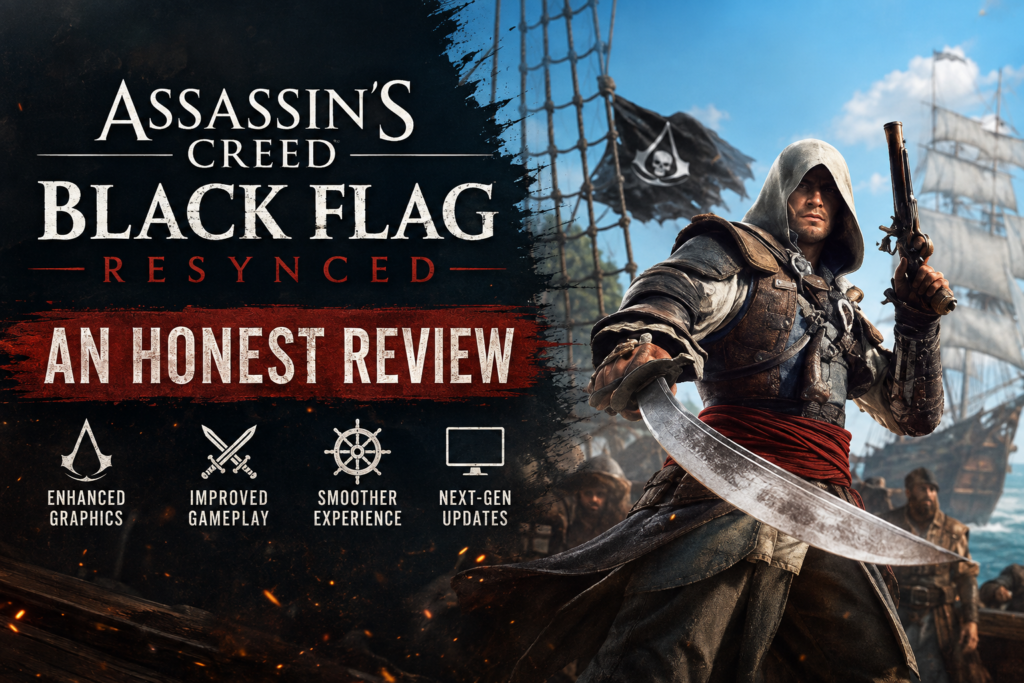
Assassin’s Creed: Black Flag Resynced — A Remake That Actually Earns Its Existence (Plus That Bonus OST)
I’ll be honest, when Ubisoft finally confirmed a full remake of the 2013 classic, my first reaction wasn’t excitement. It was suspicion. Black Flag wasn’t some rough gem that needed saving — it’s one of the most beloved games Ubisoft ever made, still gets replayed constantly, and honestly held up better than most 2013-era open-world games have any right to. So my real question going in wasn’t “is this good?” It was “did we actually need this?”
Dozens of hours across two playthroughs later, here’s where I landed: mostly yes, with a few asterisks.
First, the Basics
Resynced comes from Ubisoft Singapore rather than the original Montreal team, built on a newer version of the Anvil engine, and it launched on PC, PS5, and Xbox Series X/S on July 9, 2026. It’s not a from-scratch reimagining — it’s the same Caribbean, the same Edward Kenway, the same overall story beats — but rebuilt with new character models, environments, and mechanical overhauls layered on top.
That framing matters going in. This isn’t Demon’s Souls-style “everything is new.” It’s closer to a very thorough restoration of a building everyone already loved, with a couple of new rooms added on.
Edward Kenway Is Still the Best Reason to Play
Time has been kind to Edward as a character concept, even if some critics have started picking at his arc more than they used to. He’s not a chosen-one Assassin. He’s a broke privateer who backs into the Assassin/Templar conflict chasing money and status, and the game lets him stay selfish for a genuinely long time before he earns any growth. That’s still rare in this series, remake or not, and the new performance capture work only sharpens how good Edward’s line deliveries and expressions already were.
Combat Got an Actual Rework, Not Just a Coat of Paint
This is where Resynced separates itself from being a simple visual refresh. Melee combat now revolves around breaking enemy posture rather than just chaining counter-kills, with heavier finishers tied to whichever weapons Edward’s got equipped. It changes the rhythm of fights noticeably — you’re managing openings instead of just waiting for the counter prompt to flash.
Whether that’s an improvement is genuinely split among players and reviewers. I landed on liking it, but I get the criticism that it can trivialize smaller fights once you learn the parry timing. Either way, it’s not lazy work — someone actually sat down and rebuilt how Edward fights.
Naval Combat: Still the Star of the Show
The sailing was always Black Flag’s headline feature, and Resynced doesn’t mess with what worked. Broadsides, mortars, chain shot, and fire barrels are all back, now with secondary firing modes and new officer abilities you unlock through your crew. Watching a full naval skirmish play out on the horizon — factions clashing independently of anything you’re doing — still makes the Caribbean feel alive in a way a lot of newer open-world games don’t manage.
If you loved the ship-to-ship combat in the original, this is the section of the game that got the most obvious care.
Stealth and Traversal: Better, With Some Growing Pains
A manual crouch is finally here, which sounds minor until you actually play with it — it fundamentally changes how you approach guard patrols compared to the original’s more binary “hidden or not” system. Parkour is smoother and more responsive overall, though it hasn’t fully shaken the occasional stickiness that’s haunted this series since the beginning; you’ll still eyeball a jump, commit, and watch Edward fling himself somewhere you didn’t ask him to go.
The Bonus OST Is the Real Sleeper Hit Here
If you only take one thing from this review: track down the soundtrack. Alongside the game, Ubisoft put out a companion Sea Shanties Ultimate Collection — dozens of tracks of newly recorded, multi-part harmony sea shanties performed by the same team behind the original’s beloved crew vocals, arranged by Seán Dagher with a returning cast of vocalists and musicians. It’s available to stream on the usual platforms as its own standalone release, separate from the base Brian Tyler score.
This is the kind of “bonus content” that actually deserves the word bonus. The shanties were always Black Flag’s secret weapon — nothing else sells “you are a pirate captain” faster than your crew breaking into harmony while you’re becalmed waiting for wind — and having a expanded, high-fidelity collection of them to throw on outside the game is genuinely one of the best things to come out of this remake.
Where It Stumbles
The present-day Abstergo storyline from the original is gone, replaced by a lighter meta-progression system tied into Ubisoft’s ongoing Animus Hub framework across recent AC titles. It’s a divisive trade — you lose some of the original’s narrative texture, but you also lose some of its more tedious modern-day busywork. I land on “acceptable trade, not a clear upgrade.”
Some side missions and eavesdropping sequences got simplified in ways that streamline pacing but strip out a bit of the original’s more deliberate, patience-testing design — which, depending on who you ask, was either a flaw worth fixing or part of the charm.
Final Verdict
8/10. Resynced isn’t a reinvention, and it probably didn’t need to reinvent much — Black Flag’s bones were already excellent. What you’re getting is a genuinely well-crafted modernization: sharper combat, a more responsive Edward, the same phenomenal naval sandbox, and a soundtrack expansion that’s worth owning on its own merits. If you’ve never played Black Flag, this is now the version to start with. If you’ve already put 100 hours into the original, it’s still worth it for the shanty collection alone.
Played it yet? Let me know if you’re Team Original or Team Resynced — I’m still deciding myself.
